



In August 2020, Google introduced server-side tagging with a modest promise: faster pages, safer customer data and more control over what third-party tags are allowed to do. Six years later, one of the best-known hosting providers sells an option that encrypts analytics requests so that ad blockers cannot recognize them, and agency pages promise that server-side tracking will slash your cost per acquisition.
Same product. Opposite promises. Somewhere between the two, server-side tagging became the default answer to every tracking problem: consent rates, Safari, ad blockers, page speed, GDPR, even US class actions.
My thesis fits in two sentences. Used to send less data, more safely, server-side tagging is one of the best upgrades a tracking stack can get. Used to send the same data while showing less of it, it is the same old tracking with fewer witnesses, and that strategy is running out of road.
What server-side tagging actually is
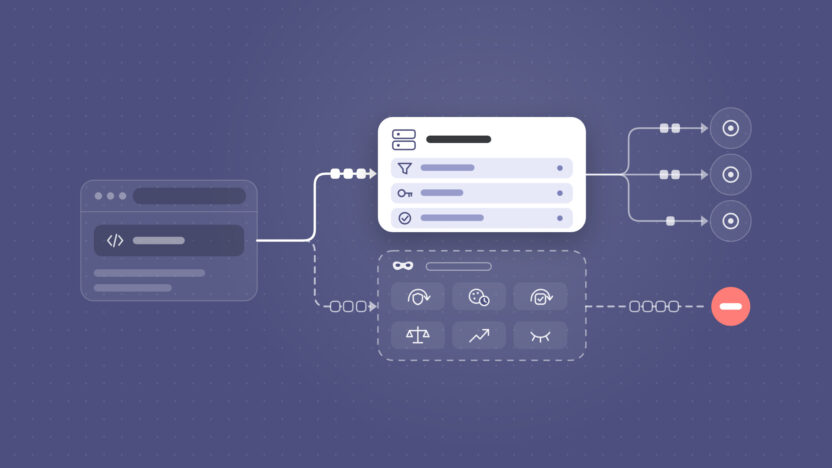
In a classic setup, the browser downloads each vendor’s script, which reads what it can and sends data straight to that vendor. With server-side tagging, the browser sends one stream of events to a server you control, usually on a subdomain of your site, and that server decides what each vendor receives. As Simo Ahava explains in his launch-day guide, it can also answer the browser, for example by setting a cookie.


Something still runs in the browser, since clicks and page views happen there, so most real setups are hybrids. And the server gives you exactly one thing: control. It is not:
- A consent mechanism. It changes how data travels, not whether you may collect it.
- A privacy exemption. Data sent from your server to Meta is still data sent to Meta.
- A data quality fix. A broken dataLayer stays broken; it just reaches more places.
- A speed guarantee. If the browser tags stay on the page, you have added a hop, not removed one.
From control to recovery
Server-side tagging arrived at a tense moment. Since 2017, Safari had been shortening cookie lifetimes, and in March 2020 it blocked third-party cookies altogether. Trackers answered with CNAME cloaking, disguising themselves as a subdomain of the site. A 2021 study found it on almost 10% of the top 10,000 sites, and by the end of 2020, Safari, Brave and uBlock Origin on Firefox had all built defenses against it. In July 2020, Schrems II put transfers to US vendors in doubt.
Google’s own pitch moved in three steps. In 2020, it promised performance and security: fewer tags in the page, and server tags that only see what you send them. In 2021, it added privacy: Consent Mode in the server and the option to drop the IP address, with a case study boasting 46% more reported conversions. In 2025, the tag gateway promised more resilient signals, with an 11% uplift that counts tag script loads, not conversions. The vocabulary had drifted from control to recovery.
The market went further than Google ever did and read the product in four ways:
| Reading | What it promised | What happened next |
|---|---|---|
| Recovery tool | Get past blockers and Safari, recover lost conversions | Blocklists now name server-side subdomains; Safari caps server cookies on IP mismatch |
| Compliance shortcut (EU) | Proxy Google Analytics to fix US transfers | The CNIL would accept a proxy only under strict conditions; consent rules never changed |
| Litigation shield (US) | Server flows are harder to prove in wiretap suits | A court dismissed server-side claims at the pleading stage; privacy laws still apply |
| Control layer | Less client code, cleaner payloads, data ownership | Holds up, and is the least marketed |
The practitioners who knew the product best warned against the recovery reading from day one. Simo Ahava’s launch guide put it bluntly: “Can you use Server-side tagging to circumvent content blockers? Absolutely. Should you? Definitely not.” Six years later, the CNAME story has repeated almost beat for beat.


What it is really for
The good uses share one trait: each makes you send less, or send it more safely. Each also comes with a condition, and the condition is what keeps it good.
| Use | What you gain | The condition that keeps it good |
|---|---|---|
| Data minimization | IP, user agent and stray personal data stripped before any vendor sees them | An allowlist of fields per vendor |
| Secrets off the page | API keys never reach the browser | Keys stored server-side and rotated |
| Private enrichment | Margin, customer value or refund status added on the server | Applied to consented events only |
| Conversion APIs | One stream feeding several vendors, plus backend events | Same consent gate; deduplication by event ID |
| One consent checkpoint | Consent checked in one place before every destination | Built explicitly for non-Google tags |
| Data quality | Payloads validated and fixed before reaching vendors | Monitoring and alerts |
| Speed and a tighter Content Security Policy | Fewer scripts and endpoints in the page | Client tags actually removed |
| Durable first-party ID | Your own analytics ID, set by an HTTP header | Consented users; server in the site’s IP range |
| Governance | One place to see, version and audit what leaves | A named owner |
Three of them deserve a word. Minimization is the use nobody puts in a business case, and the one that survives an audit. Field by field, you decide what each vendor receives, down to stripping the full IP address or an email that slipped into a URL. Private enrichment keeps sensitive values off the page: push margin into the dataLayer and any competitor reads it in the browser console; add it on the server and it stays yours. Conversion APIs let ad platforms learn from confirmed orders and refunds instead of button clicks, provided the same consent decision governs the server event and the browser pixel, and both share an event ID. GA4 only deduplicates purchases that share a transaction ID: send any other event from both sides and it counts twice.
The myths, and the bad uses they lead to
Most bad uses come from one confusion: treating a change of route as a change of rule.
“Server-side doesn’t need consent.” The browser still runs a script and sends an identifier. The EDPB’s final guidelines, adopted in October 2024, cover pixels and URL tracking, and in March 2025 a court in Hannover ruled that Google Tag Manager itself cannot load before consent. The bad use this myth leads to is a conversion API that sends events for every visitor, because nobody wired it to the banner.
“It makes Google Analytics GDPR-compliant.” In 2022, the CNIL said a proxy could only help if it replaced identifiers and IP addresses and kept data inside the EU, and a default server container forwards both to Google. Since 2023, the EU-US Data Privacy Framework gives transfers to certified US companies a legal basis of their own, so the proxy argument has lost its main justification. What never changed is that tracking still requires consent.
“It bypasses ad blockers.” Less and less: filter lists now name server-side subdomains. And a blocker is a choice the visitor made.
“Server cookies last 400 days in Safari.” 400 days is Chrome’s cap since 2022. Since Safari 16.4, a cookie set by a server outside the site’s IP range gets the same 7-day limit as a JavaScript cookie.
“It recovers 20% to 40% of conversions.” Ask what is being counted. Vendor numbers mix three very different things:


Only the first belongs in an uplift claim. The reliable test is your own: compare platform conversions with confirmed backend orders, before and after.
“Invisible means safe.” Consent scanners cannot see server flows, but every destination still belongs in your vendor list and privacy notice. In the US, discovery exposes server logs.
“It fixes data quality” and “set it and forget it” fail for practical reasons. A server forwards bad data faithfully, and when it goes down, every vendor loses data at once. Google recommends running at least two instances, at about $45 each per month, to limit data loss when a server fails.
The bad use without a myth: lift-and-shift. Teams copy every browser tag into the server one for one and keep the default templates, which often forward the full IP address and user agent. Then they leave the browser tags in place, just in case. The result is the same data flows as before, plus a hosting bill, a new point of failure and, often, double counting.
The gray zone
Some practices are neither good nor bad on their own. The technique is the same on both sides of the line; what changes is whose choice it respects.
| Practice | Defensible when | Crosses the line when |
|---|---|---|
| First-party endpoint or tag gateway | It serves consented measurement | It exists only to slip past a blocker the visitor installed |
| Extending cookie lifetime | It keeps your own analytics ID stable for consented users | It revives ad identifiers Safari shortened on purpose |
| Forwarding IP address and user agent | A vendor needs them for a documented purpose, with consent | They go to every vendor by default |
| Hashed emails and phone numbers | Consent, a clear notice, only where needed | Hashing is presented as anonymization |
| A server API instead of a pixel the browser blocks | The visitor consented and the vendor is disclosed | It reaches people the browser was protecting by default |
The hardest case: a visitor accepts your banner but runs a blocker. Measuring them through your own infrastructure respects the consent you collected. Disguising the request so the blocker cannot recognize it treats the blocker as an obstacle rather than a signal.
Browsers are drawing the same line. Safari 27, released in September 2026, blocks identity-resolution services that turn email addresses into tracking IDs. WebKit’s explanation, published on October 19, targets the email address itself, with no exception for hashed versions. And WebKit’s tracking prevention policy treats any attempt to circumvent its protections with the same seriousness as a security vulnerability.


Where I stand. I draw the line at disguise. A server that sends less, documents what it sends and follows the consent you collected is good engineering. A server whose main feature is that blockers, browsers, auditors or plaintiffs cannot see what it does builds a risk that will surface sooner or later, in an audit, a browser update or a lawsuit.
Before you route anything server-side
Start by measuring what you actually lose. Compare each platform’s conversions with confirmed orders over a few weeks, and find out how much of the gap comes from consent refusals, which a server must not recover.
Then build the unglamorous parts first. Pass the visitor’s consent state with every event, check it in the server for each destination, and test the refusal path, not just the acceptance path. Give the browser pixel and the server event a shared event ID. Serve the container from your site’s own infrastructure, because since Safari 16.4 a server outside your site’s IP range only gets 7-day cookies, and avoid predictable subdomains like sgtm., which blocklists now target by name. Then set alerts on request volume and vendor errors, and name an owner.
Finally, run every flow through seven questions. One wrong answer means reworking the design, not abandoning server-side.
- Would this data still flow if the visitor said no? If yes, stop.
- Is every destination in your consent platform’s vendor list, your privacy notice and your record of processing?
- Does each vendor receive only the fields on its allowlist?
- Did you remove the client-side tag you replaced?
- Could you explain this flow to a visitor in one sentence without embarrassment?
- Who is alerted when the container fails, and how fast?
- Will you measure the gain against your own baseline, rather than a vendor’s case study?
Conclusion: send less, don’t hide more
Server-side tagging was built to answer a real problem: too many scripts, running with too much access, sending too much data to too many companies. Control is still the only promise it fully keeps.
The market spent six years trying to turn it into something else, and each of those readings depended on nobody seeing what the server did. Blocklists now name the subdomains, Safari judges where data goes rather than where scripts come from, and regulators and courts look past the route to the rule. Even the cookieless future that sold so many server-side projects never arrived in Chrome, which decided in April 2025 to keep third-party cookies.
My prediction: the browser tag will shrink to a single, consented event stream, and most of the value will move to server-to-server flows fed by what the business actually knows, such as confirmed orders, refunds and margins. The teams that win will be those whose flows survive an audit, a browser update and a blocklist release without changing anything.
What survives is the use that never needed a disguise. After you move a flow server-side, your stack should be more respectful and more reliable, not just harder to see. Send less. Don’t hide more.
This article reflects my own views, not those of any employer or client. It is not legal advice: check your own setup with your legal or privacy team.
Sources
- Google, Improve performance and security with Server-Side Tagging, Aug 2020
- Google, Bring performance and privacy together with Server-Side Tagging, Sep 2021
- Google, Google tag gateway for advertisers
- Google, Set up server-side tagging with Cloud Run
- Google, Minimize duplicate key events with transaction IDs
- Simo Ahava, Server-side Tagging In Google Tag Manager, Aug 2020
- WebKit, Tracking Prevention in WebKit
- WebKit, Tracking Prevention Policy
- WebKit, Blocking Identity Resolution Infrastructure, Oct 2026
- Dimova et al., The CNAME of the Game, PETS 2021
- Chrome for Developers, Cookie Expires and Max-Age attributes now have upper limit, Aug 2022
- Snowplow, Safari ITP and server-set cookies, Apr 2023
- Marketing Week, Google ditches opt-out for third-party cookies, Apr 2025
- EDPB, Guidelines 2/2023 on the technical scope of Art. 5(3) ePrivacy
- DLA Piper, CNIL insights on Google Analytics, Jun 2022
- A&O Shearman, The Data Privacy Framework after the General Court’s verdict, Sep 2025
- Frankfurt Kurnit, Rethinking legal risk: technical solutions to online wiretapping (archived copy; the original page is no longer online)
- PPC Land, Explaining Google tag gateway, Sep 2026
- PPC Land, Ad blockers are now targeting server-side GTM subdomains by name, May 2026
- PPC Land, Safari 27 blocks identity firms that turn email addresses into tracking IDs, Oct 2026
- Stape, Avoid the impact of ad blockers on your tracking code, May 2026
- Nova Pixel, How server-side tracking slashes Google Ads CPA